By Gabi Neely, 2025-26 University of Montana Fire Club secretary
This year, the University of Montana Fire Club welcomed a diverse lineup of guest speakers whose experiences span from science communication, research, to operational sciences within the wildfire realm. The first guest speaker was Amanda Monthei, a writer, podcaster, and public information officer. Monthei focused on a compelling discussion of how the power of storytelling in fire culture can strengthen public understanding of wildfire ecology, operations, and resilience. She encouraged students and practitioners to see themselves as contributors to a broader cultural conversation, highlighting how effective communication can shape both policy and public perception.
Anthony Marcozzi, a research scientist working with the New Mexico Consortium and the Missoula Fire Lab, was a second guest lecturer that came and spoke to club members. Marcozzi offered insight into the rapidly evolving field of fire modeling. He highlighted his path from hands-on wildfire operations to a career in cutting-edge research developing 3D fire and fuel modeling tools. His take home message for our Fire Club students was how, meaningful and impactful careers in fire do not solely exist on the fireline but instead go beyond it. By sharing his own transition, Marcozzi highlighted the wide range of opportunities available in fire science and encouraged students to explore roles that align with their skills and interests.
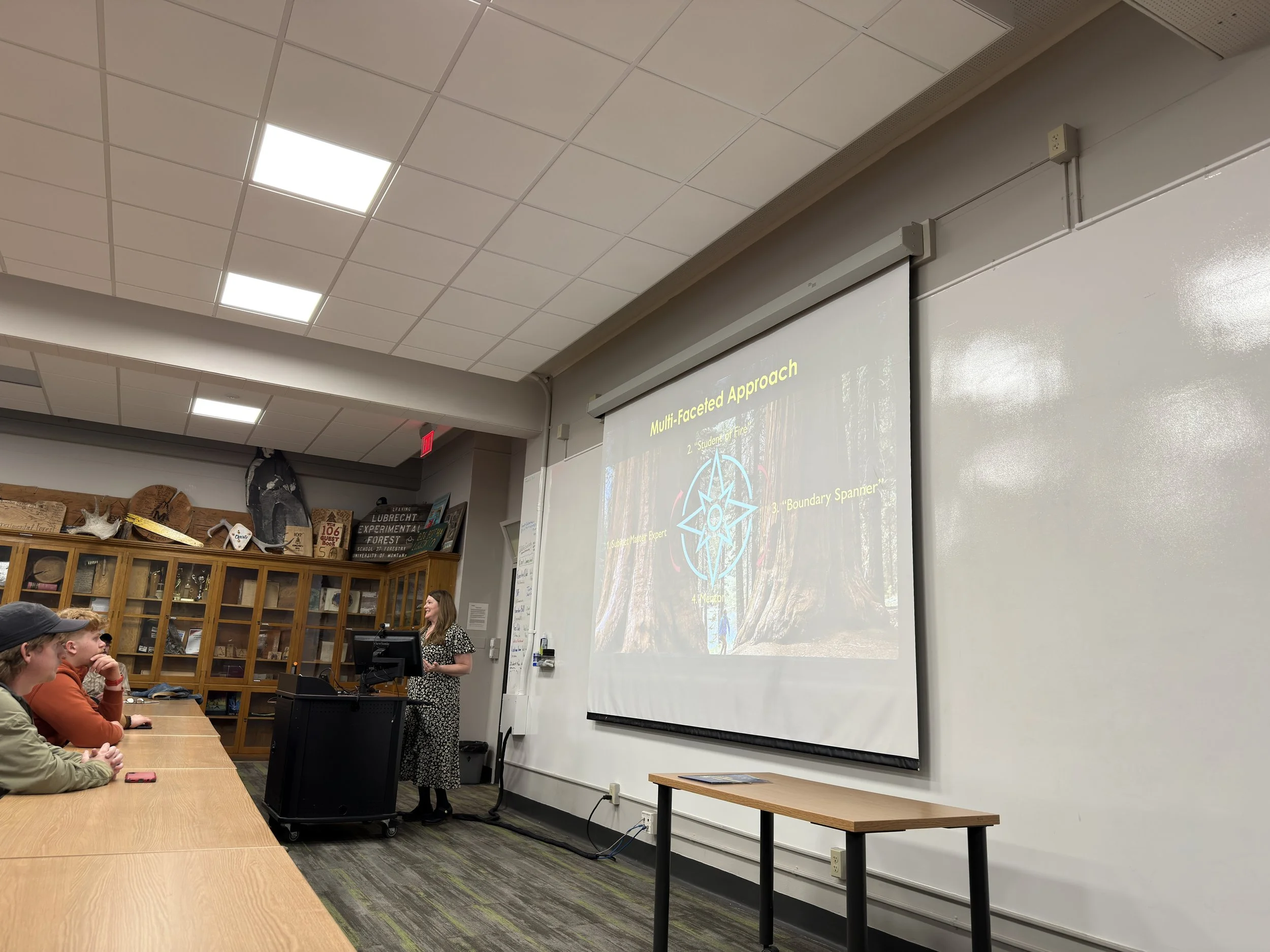
Rounding out the speaker series, Coleen Haskell brought decades of expertise in meteorology and fire weather to the Fire Club. With a career spanning over 40 years in both civilian service and within the meteorology field, Haskell described her role as a “boundary spanner,” bridging the gap between scientific research and on-the-ground fire operations. Her interdisciplinary approach to fire management emphasizes collaboration and co-management, particularly as fire behavior becomes more complex. As a dedicated mentor, Haskell encouraged students to pursue multidisciplinary paths in fire science, reinforcing the importance of integrating knowledge across fields to meet the challenges of modern wildfire management.
The University of Montana’s Fire Club is incredibly grateful to have hosted such knowledgeable and inspiring speakers this semester. Their willingness to share their time, experiences, and expertise made a lasting impact on students and overall enriched the club’s mission of fostering a deeper understanding of wildfire. The club looks forward to welcoming more guest lecturers in future semesters and continuing to build connections within the fire community.