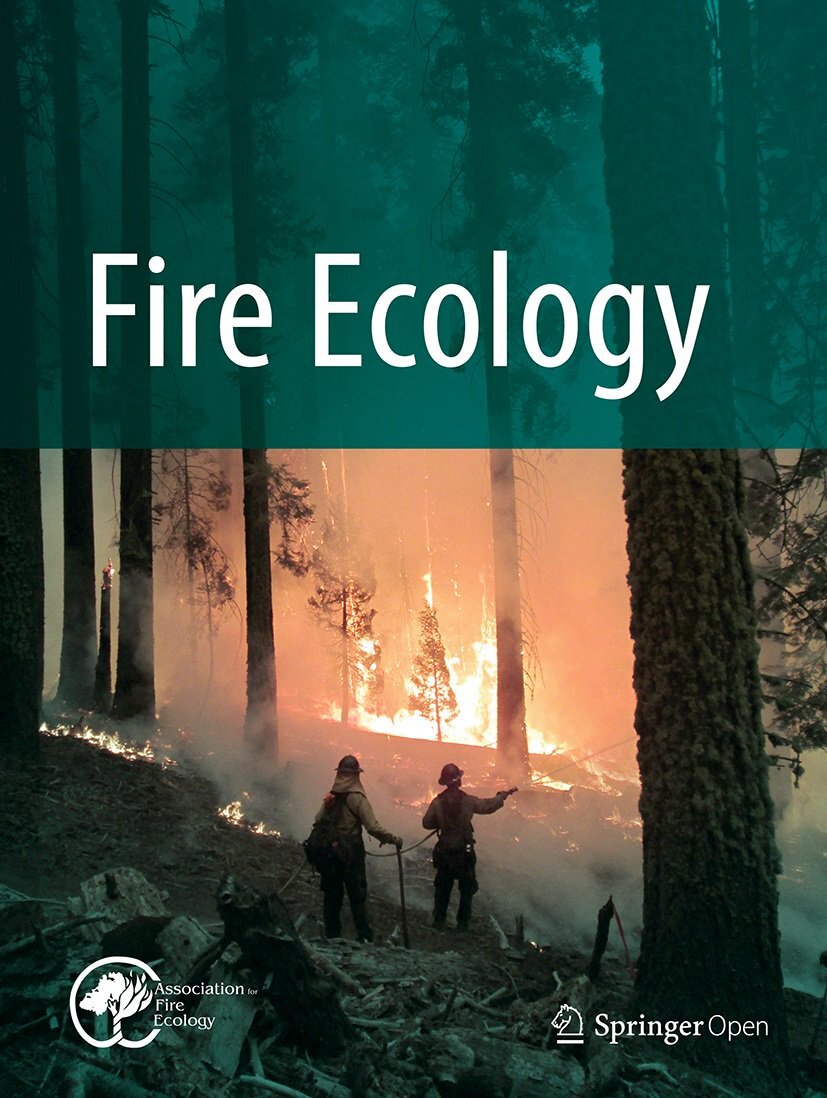
research Highlight: Complex effects of fire severity on a serotinous conifer
Author: Kyle Merriam
This research highlight summarizes an article recently published in Fire Ecology that examines how fire suppression effects species like Baker Cypress.
Key Messages:
The effects of fire severity on Baker cypress are complex, and include both positive and negative, as well as short- and long-term effects.
We found that fire severity was the most important driver of first-year postfire seedling density.
Fire severity continued to influence Baker cypress density, survival, and health over longer time frames.
Understanding the complex effects of fire on Baker cypress required both immediate postfire assessments and longer-term monitoring.
FIRE SEVERITY IS THE MOST IMPORTANT DRIVER OF FIRST-YEAR POSTFIRE SEEDLING DENSITY
First-year postfire seedling density was positively related to scorch height, but negatively affected by bole char height. Heat is required to open serotinous cones and release seeds stored in the canopy, and higher scorch heights reflect fire effects that extend further into the canopy of trees, resulting in the heating and opening of more cones. On the other hand, charring of the tree bole can indicate higher fire intensity and longer duration of exposure to heat. Although cypress require relatively high temperatures for cone opening, there are limits to the temperature or duration of heating that seeds can endure.
FIRE SEVERITY CONTINUED TO INFLUENCE BAKER CYPRESS DENSITY, SURVIVAL, AND HEALTH OVER LONGER TIME FRAMES
We found that fire severity not only determined first-year postfire seedling densities, but also had longer-term implications for Baker cypress seedlings. Seedling density, survival, and health were all higher after nine or ten years in plots that burned at high severity. These longer-term effects likely resulted from the influence of fire on the postfire growing environment for seedlings, including the negative effects of canopy closure in low severity plots, and the positive effects of nurse objects, such as rocks and shrubs, that were promoted by high severity fire. Although cone opening appeared to be the main driver of Baker seedling density immediately after fires, variables associated with increased light availability and drought stress refugia driven by fire severity were important for the longer-term density, survival, height, and health of Baker cypress seedlings.
UNDERSTANDING THE COMPLEX EFFECTS OF FIRE ON BAKER CYPRESS REQUIRED BOTH IMMEDIATE POSTFIRE ASSESSMENTS AND LONGER-TERM MONITORING
Until recently, observations of wildfire effects to Baker cypress populations were rare. There was little direct evidence of fire effects on cone opening and seedling density immediately after fires or information about how environmental characteristics affected by fires influence population dynamics over longer time frames. Our study revealed complex effects of fire severity on Baker cypress by sampling four populations immediately after wildfires and continuing data collection at two sites for an additional nine and ten years.
IMPLICATIONS FOR MANAGERS, POLICY MAKERS, AND RESEARCHERS
In an era of changing fire regimes and rapidly shifting climate conditions, sustaining Baker cypress and other species adapted to high severity fire will likely require a landscape-scale approach. To prevent extirpation, managers should reduce fuel loads and deploy wildland fire suppression tactics around immature populations. Large-scale fuel treatments, such as prescribed burning and restoration thinning in adjacent vegetation types, may be needed to encourage crown scorch that opens cones while limiting fire intensity that can kill seeds. Further research on how spatial heterogeneity supports the persistence of fire-dependent species such as Baker cypress could also help guide future restoration and conservation efforts.