Announcing the winners of the student poster contest at the 11th international fire ecology and management Congress
Last week, nearly 700 people gathered in New Orleans for the 11th International Fire Ecology and Management Congress! There was a student poster contest, and the judging team chose the following students as the 1st, 2nd, and 3rd place poster presenters. Congratulations to all!
1st place

Tanner Gordon, University of Wyoming
“A LiDAR-based inventory of forest fuels and structure on the Colorado Front Range Priority Landscape”
In Tanner’s study of 450 stratified field inventory plots across the Colorado Front Range, “LiDAR-based models successfully predicted canopy fuels and tree metrics, but lower stratum metrics such as surface fuels and regenerating stems were poorly predicted from LiDAR. LiDAR provided little information in severely burned areas, and inclusion of burned areas weakened models.”

2nd place
Cara Caruolo, Northern Arizona University
“Connecting wildfire recovery and resilience: Insights from six fires in the Southwestern United States”
Cara’s study was on on post-fire recovery and resilience across six fires in Arizona and New Mexico. Cara found through 57 semi-structured interviews that “recovery and resilience are better characterized as processes than stagnant end goals, monitoring recovery processes through quantitative measurements does not accurately represent the nuance and non-linearity of recovery trajectories, ambiguous recovery guidance benefits local-social contexts,” and social and ecological recovery and resilience are interconnected.
3rd place
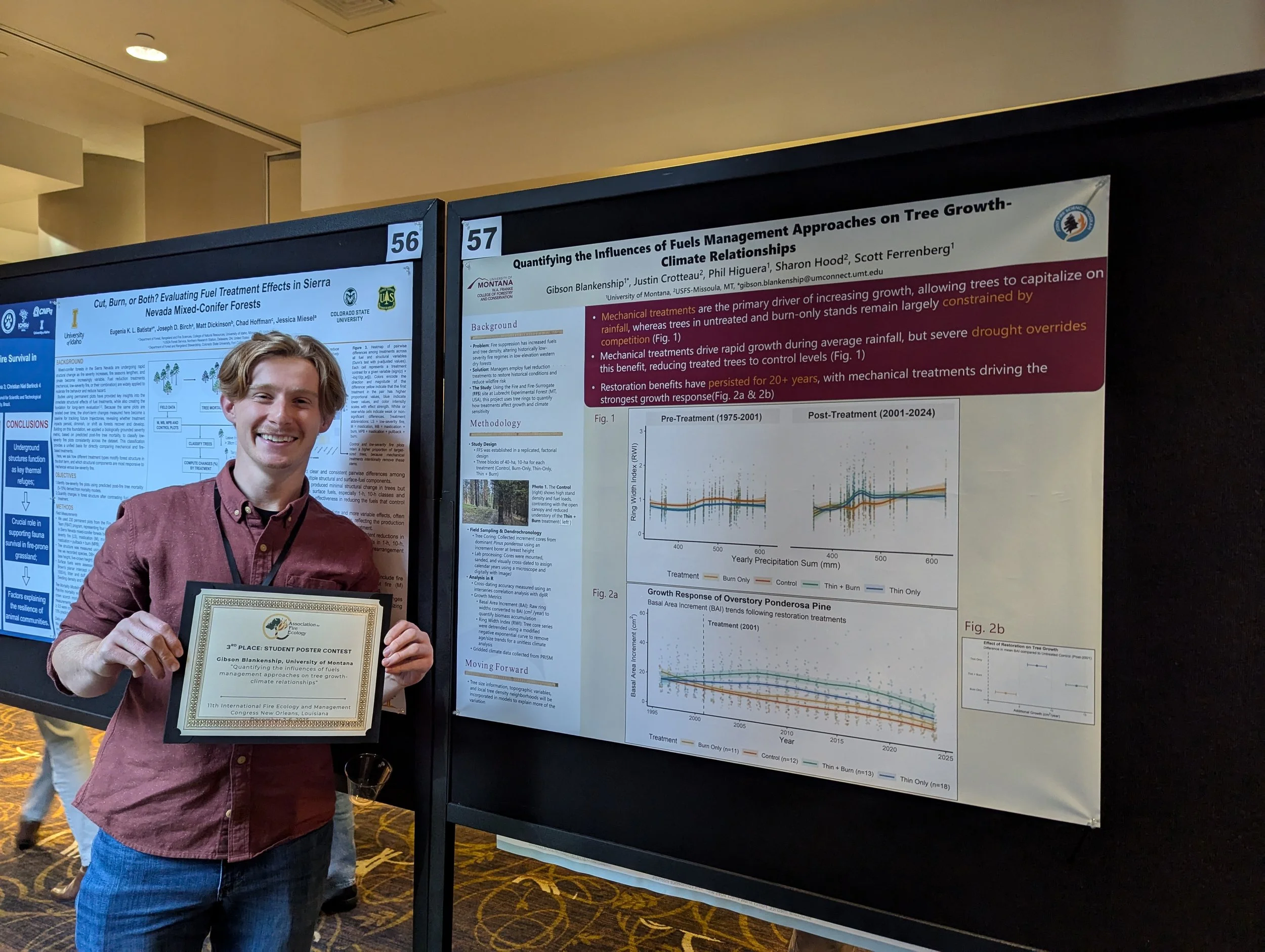
Gibson Blankenship, University of Montana
“Quantifying the influences of fuels management approaches on tree growth-climate relationships”
Using tree-ring data from the Fire and Fire-Surrogate site at Lubrecht Experimental Forest in Montana, Gibson found that mechanical treatments were “the primary driver of increasing growth, allowing trees to capitalize on rainfall, whereas trees in untreated and burn-only stands remain[ed] largely constrained by competition.”