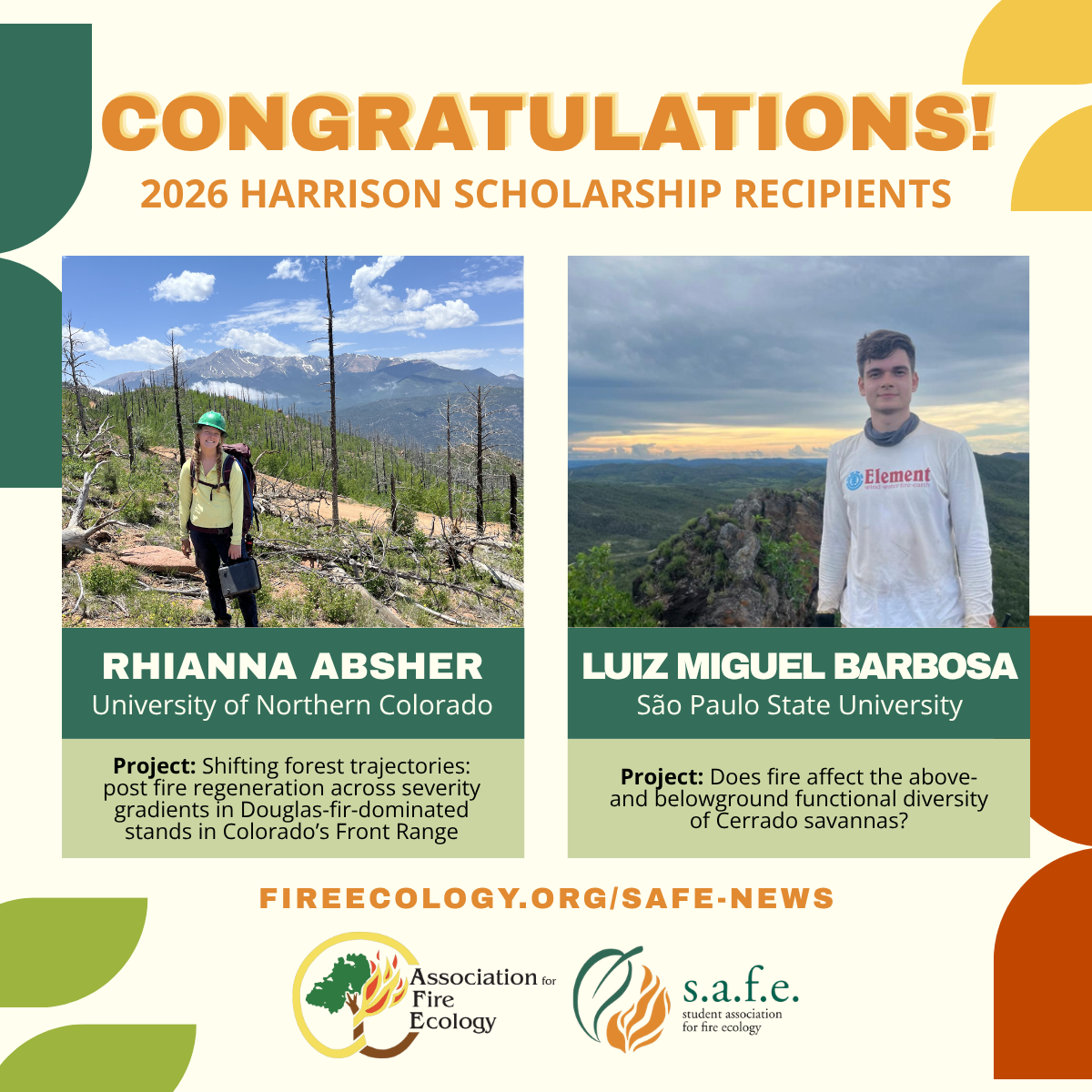
Congratulations to the 2026 recipients of the Wayne Harrison Memorial Scholarship: Rhianna Absher and Luiz Miguel Barbosa
Rhianna Absher, University of Northern Colorado
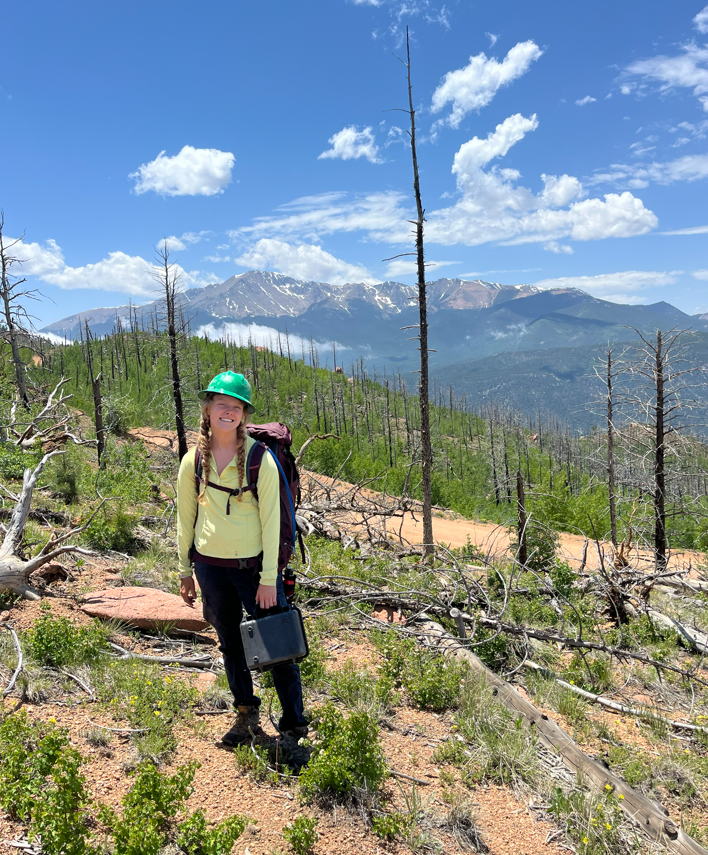
Project: Shifting forest trajectories: post fire regeneration across severity gradients in Douglas fir-dominated stands in Colorado’s Front Range
Wildland fire is a dominant ecological process in the Colorado Front Range that plays a strong role in shaping forest structure, composition, and regeneration (Romme et al. 2003; Hunter et al. 2011). Historically, fire regimes created heterogeneous landscapes, characterized by patterns of low, mixed, and high severity burns, that supported species like Douglas-fir (Pseudotsuga menziesii var. glauca) (Peet 1981; Bigio et al. 2010; Hunter et al. 2011). However, anthropogenic climate change has increased fuel aridity, extended fire seasons, and intensified fire conditions resulting in larger high-severity fires (Jolly et al. 2015; Abatzoglou & Williams 2016; Mueller et al. 2020). These changes exceed historical variability and alter post-fire regeneration dynamics.
Douglas-fir is a non-serotinous, shade-tolerant species with limited long-distance seed dispersal, making regeneration reliant on surviving seed sources and suitable microsite conditions (Harvey et al. 2013; Rhoades et al. 2025). Following high-severity fire, research has shown that complete overstory mortality and few surviving seed sources can reduce regeneration success (Chambers et al. 2016). Recent large fires in the Colorado Front Range, including the 2002 Hayman Fire and the 2012 High Park Fire, provide an important opportunity to examine Douglas-fir regeneration across fire severity gradients. Understanding how Douglas-fir post-fire regeneration responds across severity gradients can help identify potential ecological thresholds. These ecological thresholds will be essential for predicting future forest resilience under rapid climate change and increased wildfire activity.
This project asks: How does Douglas-fir regeneration change along fire severity gradients within the Hayman and High Park fires? I hypothesize that regeneration is lower in high severity burned plots, and that it is expected to find a threshold along the fire severity gradient.
Specific aims are to: (1) quantify differences in Douglas-fir regeneration across fire severity gradients, (2) identify a critical point along a severity gradient at which Douglas-fir regeneration sharply declines, indicating an ecological threshold, and (3) evaluate whether these relationships are consistent between the two fires.
Luiz Miguel Barbosa, São Paulo State University
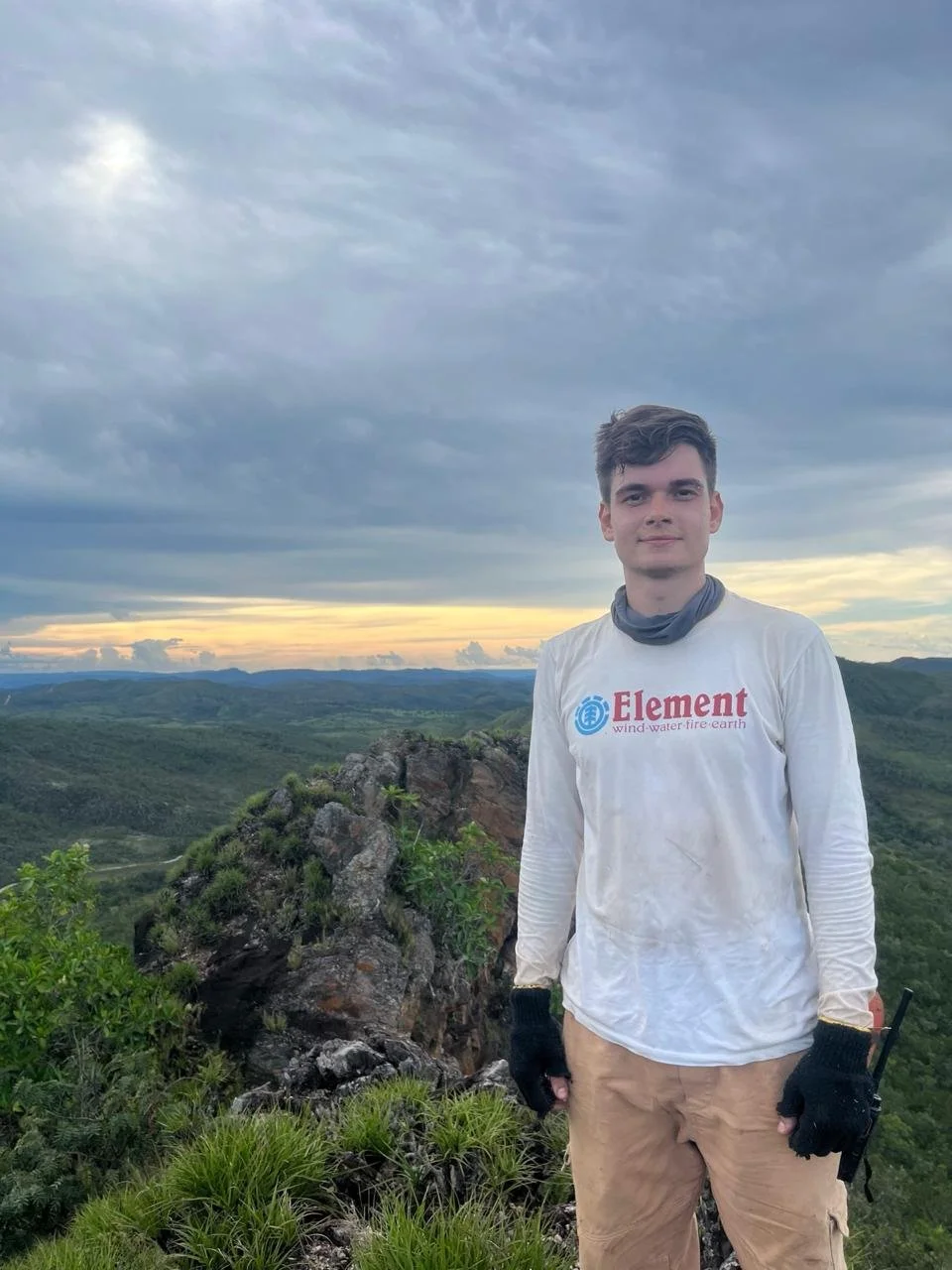
Project: Does fire affect the above- and belowground functional diversity of Cerrado savannas?
Post-fire regeneration of herbaceous vegetation in tropical savannas such as the Brazilian Cerrado is largely mediated by belowground bud-bearing organs, which confer ecosystem resilience and contribute significantly to carbon storage. Despite their importance, the species composing this compartment and their belowground biomass remain underrepresented in functional studies. This reflects a historical bias in which ecological frameworks are generally built on aboveground traits of Northern Hemisphere species. This gap limits our understanding of how Cerrado species with specialized belowground structures are positioned within global functional spectrums, particularly regarding plant acquisitive and conservative strategies.
My research investigates how extreme fire regimes—ranging from high-frequency burning (29 fires since 1985) to long-term fire exclusion (only one fire since 1985)—shape the functional diversity and biomass allocation of the herbaceous-shrub layer. Conducted at the Reserva Natural Serra do Tombador (RNST) in Central Brazil, this project employs a community-based approach. I excavated 318 individuals across 58 dominant species to evaluate a comprehensive set of 12 traits. These bridge classic economic gradients (e.g., specific leaf area, leaf nitrogen, height, specific stem density) with belowground traits poorly integrated in global functional gradients (e.g., specific root length, root tissue density, root nitrogen, belowground bud bank, clonality, and belowground organ type).
A core focus of this work is testing the hypothesis that frequent fire maintains higher functional diversity than fire exclusion, and that plants in frequently burned areas exhibit a higher above:belowground biomass ratio. I propose that while extreme regimes are not ideal, fire exclusion poses a severe threat to Cerrado biodiversity by driving woody encroachment and suppressing the herbaceous layer. In contrast, while frequent fire also exerts environmental pressure, species with belowground persistence traits can navigate this high-regime landscape more effectively than those in long-suppressed systems.
As the lead Master’s student on this project, funded by the São Paulo Research Foundation (FAPESP), I am responsible for the fieldwork (completed in early 2026), laboratory processing, data analysis (PCA, GLMMs), and manuscript preparation. Laboratory trait measurements are currently underway and will be completed by October 2026. By decoupling resource acquisition from persistence strategies, this project will provide a critical trait database to better understand tropical savanna resilience under changing fire regimes.