Treating Dry Forest Landscapes to Promote Functioning Fire Regimes in the 21st Century
Southwest FIre Science Consortium
March 24, 2026 11am PT/2pm ET
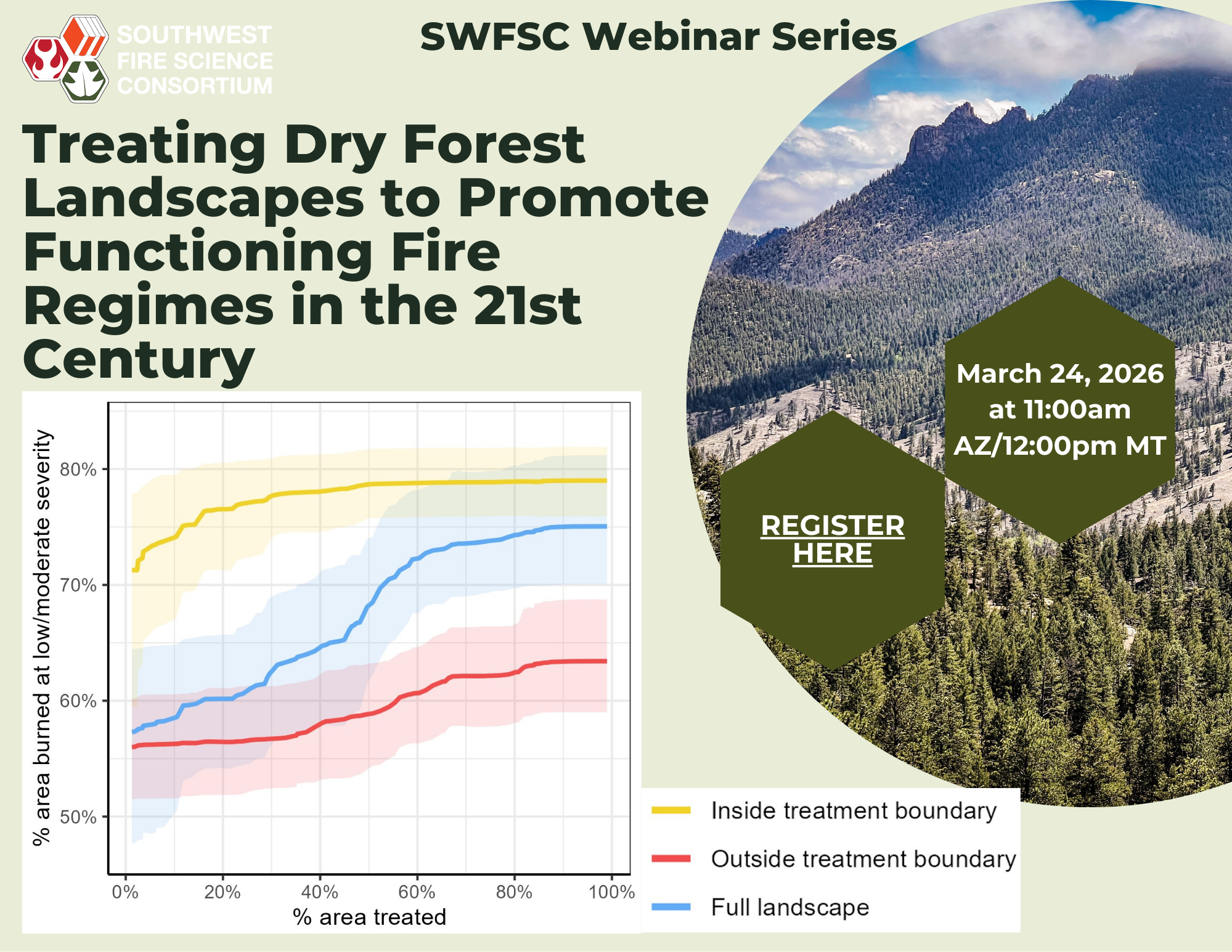
Shifting fire regimes driven by fire suppression, fuel accumulation, and climate change are threatening the persistence of dry forest landscapes across the western United States. Managers are increasingly investing in restoration and fuel reduction treatments, yet key questions remain about how much of a landscape must be treated to reduce burn severity and restore functioning fire regimes. This presentation will dive into the results from an analysis of 5,084 fires over 16 years which allowed researchers to 1) quantify burned landscape treatment composition and 2) evaluate how the percentage of area treated influences inside-boundary, outside-boundary, and cumulative fire effects across three spatial scales and three major ecoregions. Join us to learn about a) how increasing treated area generally increases the proportion of low- to moderate-severity fire effects at the landscape scale, driven primarily by strong inside-boundary effects with measurable, though smaller, “shadow” effects beyond treatment edges, and b) the complementary roles of mechanical treatments, prescribed fire, and managed wildfire in achieving landscape targets of roughly 40–60% area treated.
Presenter: Caden Chamberlain, Senior Forest and Fire Ecology Research Associate with the Colorado Forest Restoration Institute